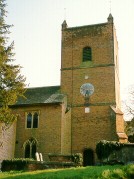
From — Some Ancient Churches in North East Hampshire
It is interesting to notice the string of hamlets (Bentley, Froyle,
Holybourne) which grew up between Farnham and Alton along the route of the
Pilgrims Way. One wonders how, when land was freely available, these
hamlets came to be established so close to each other.
Froyle church was established possibly later than its two neighbours,
Holybourne and Bentley, by the nuns of St Mary's Abbey at Winchester.
It was built in the early part of the 14th century, but there was an earlier
church, for we have records of a vicar being there in 1274, and a recent
archaeological dig in the nave revealed a pre-Norman foundation.
The tower at the west end was rebuilt, in 1722, using Crondall brick. The
wide nave of 1812 is by the architect James Harding of Farnham.
The east window is large for a village church and is a striking feature,
with five lights. The glass in the upper tracery, a rare surviving treasure,
dates from the early 14th century. There is also a fine Tree of Jesse, a
late 19th century work by Burlison & Grylls. The north wall of the sanctuary has an aumbry which, unusually, retains its 14th century wooden door - a feature shared in our area only with the church of St Mary the Virgin in Bramshott.
In the north wall of the sanctuary also, covered by a curtain during Holy
Week, is the Easter Sepulchre, which is believed to be contemporary with the
building of the church. The Froyle church leaflet gives an interesting
account of its history.
In the south wall, opposite the altar, is a 15th century piscina. Unusually,
one steps down into the chancel, as the floor of the nave was raised when it
was rebuilt in the early 19th century. The restorers retained the gallery
at the west end of the church.
A large wooden statue of the Virgin Mary has been placed in the north east
corner of the nave. This is a memorial to Sir Hubert Miller, the last
active Lord of the Manor, who used to bring statues back from Italy - many
of these can be seen over the doors of cottages in Upper Froyle, thus
originating the name "The Village of Saints".
On the walls of the nave are eight hatchments. These were displayed
outside the houses where local knights entitled to bear arms had died.
After the mourning period was over, the hatchments would be moved into the
local church. It is unusual to find so many in a village church.
Close by the church is the Lord Mayor Treloar Lower School, which houses
and educates disabled children.